A First Visit to a Public Square: What to Notice
A first visit to a public square feels easier when you know what to notice: entrances, seating, activity and quieter edges before choosing where to pause.
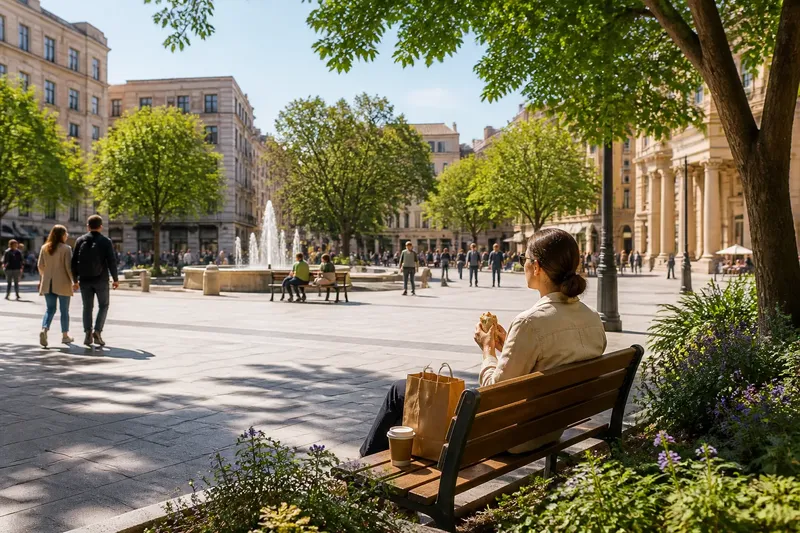
Where should you begin on a first visit to a public square when you do not yet know its entrances, seating or daily rhythm? Start with the feature you came to use: a meeting point, a place to eat, a clear route across or a seat with a particular view.
You do not need to inspect every corner. A square makes more sense when you connect its details to your own purpose: a fountain may help you meet someone, while a low wall might suit a brief lunch. Treat the space less like a puzzle and more like a room with several doors and different places to settle.
Choose a purpose before you choose a place
Decide what would make this visit useful. Are you crossing the square, waiting for a friend, taking a break or keeping an eye on children? Each purpose points towards different details, so you can spend your attention where it helps.
- If you are crossing it, check whether a direct route connects your entrance to the far side; if it is clear and suitable, take it, but if an event or obstacle blocks it, use the visible alternative route.
- If you are meeting someone, check whether a fountain, artwork or distinctive tree is visible from your agreed entrance; if it is, choose a specific side of that feature, but if not, agree on a more visible landmark.
- If you want to sit, check whether a bench faces the activity or a quieter edge; if the view suits your break, use it, but if the area feels exposed or busy, look for another seat.
- If you are visiting with children, check whether you can see the play area from the available seating; if you can, choose a seat with that view, but if planting or a structure blocks it, move to a clearer position.
- If you want a pause, check whether an edge has both a place to stop and a clear view of the way out; if it does, settle there, but if the route feels awkward, choose a more open spot.
- If you use a mobility aid or push a pram, check for a continuous route without steps and for surface changes; if the route is passable for you, follow it, but if it is obstructed or unsuitable, use another entrance or route where available.
Say you arrive carrying a takeaway lunch and want a calm seat. The central benches are full, while a bench beside a planted border is vacant and still visible from the entrance. You choose the border seat; the observable result is a place to eat with some distance from the busiest seating, though the nearby entrance remains in view. If it proves noisy, you can move rather than treating the first choice as a commitment.
Notice what the entrances connect to
Look at the nearest entrance and what lies beyond it. A broad opening beside a bus stop may lead towards a busy street; a passage between buildings may feel more tucked away. Paving changes, steps, ramps, signs and crossings can all shape how an arrival feels.
Then notice what the entrance leads towards inside the square. A path may point to a fountain or seating area, while an open paved surface may invite people to choose their own line. A temporary stall, event setup or group of people can change the route that seems easiest.
Rather than tracing every path, pick the entrance that serves your purpose. If you need a particular feature, look for a route that reaches it without unnecessary detours. If step-free access matters, check the actual surface and route at ground level; local layouts and access arrangements differ.
Read seating by its view and setting
Notice where benches face. A seat aimed at the centre offers a view of activity; one turned towards planting may feel more removed. A bench beside a path can be convenient for a short wait, but passing conversation may make it less restful.
Check nearby uses as well. Seating beside a café may suit a meeting, while a bench near a playground may help you stay connected to children’s play. Sun, shade, wind and noise can also change how comfortable a spot feels during the day.
Do not assume the most prominent bench is the best one. Choose according to the view and surroundings you want, then change seats if those details do not suit you.
Read activity as a moment, not a permanent rule
Notice what people are doing rather than simply counting how many are present. Some may be crossing, chatting, eating, playing or waiting. A market stall, maintenance work or organised event can temporarily reshape the space.
A lively entrance may quieten after a group passes; a calm corner may fill when an event ends. If you have only a short visit, treat what you see as a snapshot. You can make a useful choice now without deciding that one moment describes the square all day.
Watch how different uses sit beside one another. People may cross through the centre while others sit near the planting. These patterns can help you find a suitable spot, but they do not mean that any part of a shared square belongs to one group.
Use the edges when the centre does not suit you
The edge of a square may offer planting, a low wall, a colonnade or a view of the street beyond. These features can provide a clearer boundary than the open centre. Look for an edge that also leaves you a straightforward way to reach an entrance or another part of the square.
Quiet does not always mean comfortable. A secluded corner might have no seat, a blocked view or an awkward route out. If a spot feels too isolated or difficult to leave, choose one with more visibility or activity.
In a crowded square, avoid settling in a narrow passage or directly across an entrance. If the available edges are also busy, keep moving towards an open area rather than forcing a pause into a route people need.
Which details help you settle in?
Do I need to walk around the whole square?
No. Look towards the nearest entrance and the feature you need, then decide whether that is enough to find a route or seat. Explore farther only if your purpose calls for it.
How do I choose a meeting point?
Choose a distinctive feature that is visible from your agreed entrance, such as a fountain or artwork. Specify which side to wait on; if the feature is hard to see, agree on a clearer landmark instead.
What if the square feels crowded or noisy?
Look for a seat near planting or away from the busiest activity, and check that you can still reach an entrance comfortably. If no spot suits you, leave the square and pause elsewhere.
Should I return at a different time?
Return if you want to see how events, work or everyday activity alter the space. For a single visit, choose based on what is happening now and keep your impression open to change.
Let one useful detail shape your next choice
Before leaving, notice which detail helped most: the entrance that led to your destination, the bench with the view you wanted or the landmark that made meeting easier. That is enough to make your first visit to a public square more straightforward without turning it into a rating exercise.
On a later visit, a different entrance or a new purpose may change what you notice. If you remember the detail that mattered this time, you will have a useful starting point for choosing differently next time.