How to Read Descriptive Street Names on a City Walk
Read descriptive street names as neighbourhood clues, connect them to visible landmarks and route links, and remember an unfamiliar walk without mistaking guesses for history.
How can descriptive street names help you remember an unfamiliar route without turning a guess into local history? A name such as Mill Lane or Quarry Road gives you words to notice, but the useful clue is how those words relate to the street you can actually see.
Read the full name before interpreting it
Start with the sign. Copy the exact wording, including its ending: Lane, Road, Street, Yard or Passage. These terms may reflect local naming habits, but they are not dependable descriptions of a street’s present shape.
Next, separate the parts of the name. “Mill Lane” might point to a mill, an owner or a name chosen for another reason. “King’s Road” suggests a title, but does not tell you who selected the name or when. The words offer questions to investigate, not proof of an origin.
Pick out one distinctive word rather than trying to memorise every sign. A name can work like a label on a key: it helps you recognise the right thing, but does not explain everything attached to it.
Match the name to the street you can see
Look for features the name might bring to mind: a stream, a slope, a market, a former industrial building or a path towards another part of the neighbourhood. The feature may have changed or disappeared. Treat a resemblance as a prompt for further checking.
Then follow the route. Notice which streets it joins, whether it leads towards a place with a related name, and what stands at its junctions. Those connections are useful for remembering where the street goes, even if the name’s origin remains unclear.
Keep observation separate from interpretation. “A stream runs beside the pavement” is something you can see; “the street was named for the stream” is a possible explanation that needs supporting evidence.
Check a name’s history without overstating it
For a particular name, consult local maps, council street-naming records, library collections or a neighbourhood history group. These sources can offer context that a street sign cannot. If accounts differ, keep the disagreement visible rather than choosing the most appealing story.
Residents may also use an older name, a nickname or a pronunciation not shown on the sign. These are valuable clues to how people talk about a place, but they are distinct from an official record. Note who uses each version and in what context.
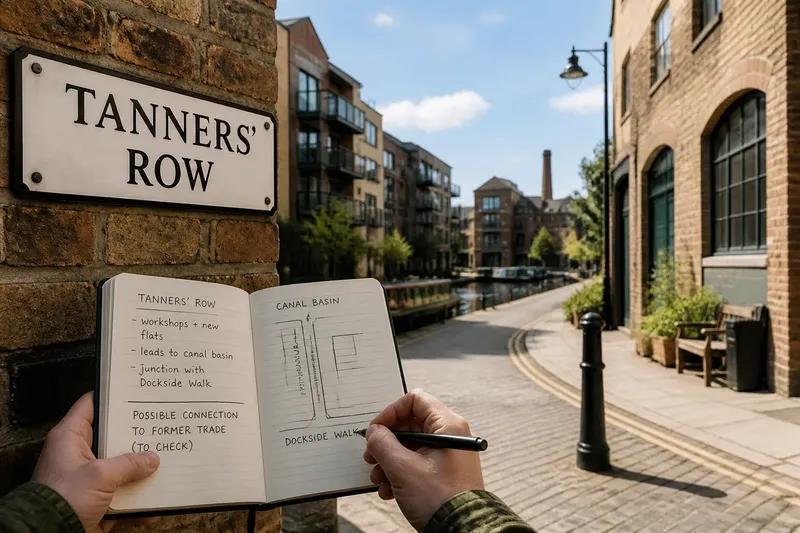
Imagine you are walking through an invented neighbourhood and see “Tanners’ Row” beside workshops and newer flats. You write down the name, notice that the street leads towards a canal basin, and mark “possible connection to a former trade” as a question. Later, you check a local map and a library collection; if neither supports the link, you keep the route note but leave the origin unconfirmed. The result is a useful memory without an invented history.
Descriptive names and numbered streets serve different purposes
A descriptive name gives you a verbal association. That can make a street easier to recall, especially when the name connects with a landmark or a familiar local word. But similar names can be confusing, and a name may outlast the feature it seems to describe.
A numbered street can fit neatly into an orderly address system, though the number is easier to interpret when you know the surrounding layout. The two approaches can coexist: a city may have numbered roads, named lanes and formal addresses in the same area.
Neither kind of label works equally well for every person or task. A visitor may remember a distinctive name; someone using a directory may find consistent numbering easier to follow. Read each label alongside the route and its connections.
What can a street name tell you?
Does a descriptive name prove what used to be there?
No. It gives you a possible lead, not a documented account. Check local maps, council records or library collections before presenting an explanation as established history.
Why do cities use numbered streets?
Numbering can help organise addresses and routes within a consistent system. Its usefulness depends on the layout and on whether you have enough context to interpret the sequence.
Do Lane, Road and Street describe how a route looks?
They may reflect local convention, but their use varies and may not match the street’s current appearance. Follow the route itself instead of relying on its suffix.
How can I remember an unfamiliar street name?
Write down the exact name, one visible landmark and the next street it meets. Linking the wording to a real point on your walk gives you more to recall than a list of names alone.
Record route clues and choose what to check next
A compact note can preserve what you observed while making uncertainty easy to spot. For each street, record its name, direction of travel, neighbouring street and one visible feature. Use the checks below to decide whether a note is ready to use or needs another look.
- Check whether you copied the full sign, including its suffix. If the wording is complete, keep it as your route label; if part is missing or hard to read, check the sign again before relying on it.
- Check whether your landmark is directly visible from the street. If it is, record what it is and where it sits; if it is not, mark it as something to verify rather than a confirmed clue.
- Check which street the route meets next. If the junction is clear, add that street to your note; if several connections are possible, follow the route or consult a map before choosing one.
- Check whether an explanation is an observation or a guess. If you can see the feature, write it under “observed”; if the name’s origin is uncertain, put it under “possible explanation” and seek a local source.
- Check for a local nickname or older name by asking residents or consulting local collections. If you find a version, record who uses it or where it appears; if accounts conflict, keep both rather than treating one as settled.
- Check whether the street name has changed by comparing an older map with a current council record. If the wording differs, note the versions and their sources; if you cannot verify a change, keep the older form as an unconfirmed lead.
Street names are most useful when they help you recognise a place and trace its connections. Use descriptive street names as route clues, then check local sources when you want to explain their history. On your next walk, one carefully recorded sign, landmark and junction may be enough to help you find the turn again.